

Lecture entitled "Publishing in the Scientific Journals"

As part of the cultural season of the Environmental Research Center
The Lecturer Dr. Mohammed Moayad Taha delivered a lecture entitled "Publishing in the Scientific Journals" on Thursday, 9/5/2019,
where the lecture summarized the following:
-
Outputs of the scientific research play an effective and fundamental role in the advancement of societies as the true results of a painstaking research effort leading to the problems that can solve it, push towards the progress and discovery, and invention of what the human needs for the welfare of various kinds.
-
Publishing in scientific journals affects the calculation of the number of users who use the research as a reference, indicating its importance in both scientific and applied terms, and affects the author's account by increasing the value of H-index of the author and university for the number of research and the time of its use.
-
According to Scopus statistics for the last twenty years, Iraq has published in all specialties about 11 thousand research, while Turkey published 434 thousand, Iran 333 thousand, Egypt 137 thousand, Saudi Arabia 111 thousand, UAE 31 thousand, Jordan 28 thousand, Lebanon 20 thousand, Kuwait 18 Qatar, 13,000, Oman 12 thousand, Syria 5,000, Bahrain 4,000, Palestine 4,000, Yemen 2,000.
-
The number of researches published for the best five Iraqi universities since its inception was as follows: University of Baghdad 4009, University of Mosul 2138, University of Basra 1817, University of Technology 1270, University of Mustansiriya 752 researches.
Recommendations:
-
Conducting a workshop on the important steps for scientific publication.
-
Encouraging lecturers and researchers to publish through financial rewards or through moral support as grants of a letter of thanks and appreciation from Chancellor of University for each research published and for all participants, as is the case in most of the world's distinguished universities (or limit the number of covered to five); or the allocation of a fixed reward for each research to be divided among the participants, which increases the number of citation and H-index for researcher, university and country.
-
Include all participants in the research (or determine the number of covered up to five researchers) in scientific promotions and performance evaluation.
-
Urge lecturers and researchers to cite each other's research to increase the citation rate and the H-index of researcher and university.
-
Urge postgraduate students by giving them a grade on the discussion (or on the general average) for each research published by the student in scientific journals or considering the publication of at least one of the requirements for obtaining the certificate.
-
Open a free scientific translation office (or a nominal fee) for lecturers and students, since English is the main obstacle in writing and publishing research in scientific journals.
-
The university should participate in one of the scientific publishers or international libraries (such as Science Direct) to provide the references needed by the writer to support his research for free, which increases the acceptance of publication in the journals.
-
Encouraging lecturers and researchers to open an account in specialized scientific publishing sites such as; Google Scholar, ResearchGate, Publons, ORCID, Academia because they help to spread knowledge and thus increase the percentage of citation.

Symposium on "Environmental Impact Studies for Development Projects"

University of Technology in the service of the community
The Environmental Research Center - University of Technology held its scientific symposium
Environmental Impact Studies for Development Projects
On Tuesday, 30/4/2019 in the hall of the green hall in the center

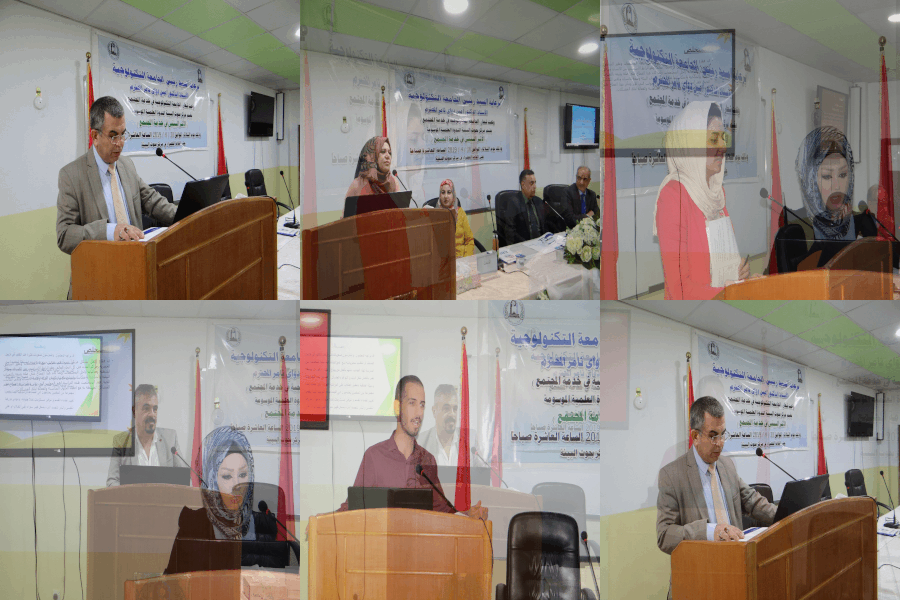


The seminar included five working papers as follows:
- The first working paper (the unit of treatment of juice as an environmental enhancer) by the President of Engineers, the oldest Suad Abdul Mahdi / Municipality of Baghdad - Department of solid waste and the environment.
- Second Paper (Environmental Impact of Degradation of Palm Cultivation) by Eng. Sarah Duraid Ahmed / Ministry of Environment - Technical Department.
- Working Paper III (Soil Management of Sustainable Soil Sustainability) delivered by Assistant Professor Dr. Saleh Abdul-Redha Saleh / Environmental Research Center - University of Technology.
- The fourth working paper (public transport and its impact on improving the environment), by Engineer Alaa Rashid Hamdan / Ministry of Housing and Construction - General Directorate of sewage.
- Fifth working paper (recycling and use of basic procedure) delivered by Assistant Professor Dr. Saleh Abdul-Redha Saleh / Environmental Research Center - University of Technology.
The seminar included a presentation by the representatives of the Palm Development Organization and the Environment Director of Baghdad, Mr. Muthanna Hasan Saloumi.
The symposium ended with a series of recommendations.
Symposium on Improving the Environment of the Brick Industry

In light of the importance of strengthening the basic role of universities in building the society in all its developmental fields, including health, economic, scientific and cultural, and to address the problems that confront our daily life and in a scientific and technical manner aimed at proposing successful solutions that serve the community, Environment for the Middle Region The symposium entitled "Improving the Environmental Reality of the Brick Industry" was held on Thursday 18 April 2019 at the Green Hall in the center.
The seminar included four working papers as follows:
The first working paper (the environmental reality of the brick factories in Iraq) presented by the former chief architect Eng. Thabet Khalil, Assistant Director General of the Department of Protection and Improvement of the Environment of the Middle.
The second working paper (the brick industry in Iraq between Iraq and ambition), presented by Mohannsen President Aked Ali Akhtar Ahmed / consultant engineer in the Directorate of the mark for industrial development.
The third working paper (Brick industry in the public sector / problems and solutions and the treatment of industrial claims) Chief Engineer Majed Jassim Hamoudi and the chief engineer of the oldest Ghani Awad Hassan / General Company for Construction Industries.
The fourth working paper (Experiment of the operation of traditional brick factories using LPG), which was given by the assistant head of engineers Shaima Ahmed Issa from the gas filling company.
A lecture by Assistant Professor Dr. Amer Majid Al-Dabbagh / Machinery and Equipment Engineering / Technological College.
The symposium concluded with a number of recommendations that will be mentioned after being approved by the Board of Directors.


Lecture "Analytical Applications of Spectroscopy of Absorption of Visible Radiation - Ultraviolet"

Assist. Prof. Dr. Saadi M. D. Al-Nuzal present a lecture entitled "Analytical Applications of Spectroscopy of Ultraviolet Radiation Absorption" on a number of graduate students PhD and MA in the laboratories of the Department of Environmental Pollution, ERC. The lecture included the theoretical basis of this technique and Lambert Bauer's law and its applications. It also included the description of components of the commercially available spectrophotometers and their types and how they are used for the quantitative analysis of many natural, industrial and medical materials and in academic studies. A laboratory demonstration was made of how to use this spectrophotometer to measure the spectrum of a certain known compounds and identify them by the wavelength of absorbed chromophoric groups and how to take the advantage of the molar absorptivity constant for each absorption peak in the compound.

Lecture entitled "The Fate and Effect of Detergents (Surfactants) in Tigris River within Baghdad City / Iraq"
As part of the cultural season of the Environmental Research Center,Lecturer Rana Riyad Khalil delivered a lecture entitled "The Fate and Effect of Detergents (Surfactants) in Tigris River within Baghdad City / Iraq" on Tuesday, 16/4/2019, where the lecture summarized the following:
The aim of this study is to determine the quantity and quality of surfactants (anionic (AS) and nonionic (NS)) in Tigris River and Al- Rustamiya wastewater treatment plant (RWWTP) (before and after treatment). Six sites were selected for this study and samples were collected from water, particulate, sediment and submerged plant in the river, while the treatment plant included water and particulate for the period from February 2017 to February 2018 and results were expressed as seasonally (wet and dry). Some physicochemical parameters are also measured at all sites per months. Two analytical methods were used photolab (PHD) and HPLC device for surfactants.
Also Person's correlation coefficient, Principle component analysis (PCA) and Factor analysis (FA) (multivariate statistical methods) were used as a tool to interpret the correlation between physicochemical parameters (for all six sites and two analytical methods) with surfactants.
From this study, the concentration of anionic and nonionic surfactants was in the following order: Particulate > Aquatic Plant > Sediment > Water. The RWWTP revealed its efficiency as treatment processes for anionic and nonionic surfactants where compared with permissible limits of use for irrigation purposes after treatment.


